11) Rhapsody in Blue (Manhattan, 1979, dir. Woody Allen)
New York is one of the great mythical cities, in that there is the New York that is real and there is the New York that is a fantasy of our minds. Allen captures this magical New York perfectly in the opening of Manhattan, using classic black and white photography as well as the signature George Gershwin tune.
Showing posts with label 1960s. Show all posts
Showing posts with label 1960s. Show all posts
Sunday, June 20, 2010


Friday, June 18, 2010
Criterion Fridays - Loves of a Blonde
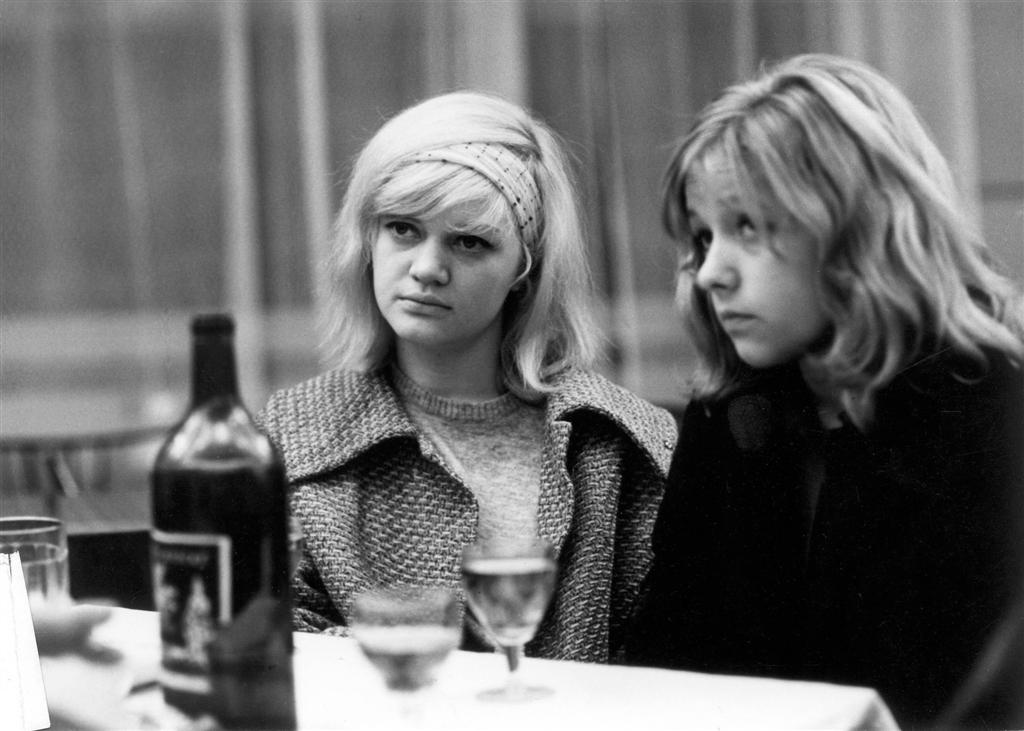
Loves of a Blonde (1965, dir. Milos Forman)
My familiarity with director Milos Forman comes mainly from his work in English language cinema (One Flew Over the Cuckoo's Nest, Amadeus, Man in the Moon), but I have been aware for a long time of the movies he honed his craft with in his native Czechoslovakia. I didn't know much about them, other than from reviews and criticisms they were akin to the French New Wave youth culture movies, but with a more anti-authoritarian bite. One thing I've found in art that is hard to translate between languages and culture is humor. Jokes are a product of the experiences and philosophies of a specific group of people, and the broader the joke (i.e. slapstick comedy) the larger the audience you can appeal to. Humor of language or subtle situations is much harder to get a foreign audience to laugh at. However, Forman conquers that challenge with expertise.
Monday, June 14, 2010
My 40 Favorite Film Moments - Part 2
6) Waiting For a Train (Once Upon a Time in the West, 1969, dir. Sergio Leone)
Wordless, with a soundtrack provided by found objects in the setting. A squeaky windmill, a dripping water tower, the steady rhythm of a steam engine. It provides the perfect introduction to the film's protagonist, Harmonica (Charles Bronson).
Wordless, with a soundtrack provided by found objects in the setting. A squeaky windmill, a dripping water tower, the steady rhythm of a steam engine. It provides the perfect introduction to the film's protagonist, Harmonica (Charles Bronson).
Friday, June 11, 2010
Criterion Fridays - Knife in the Water

Knife in the Water (1962, dir. Roman Polanksi)
Starring Leon Niemczyk, Jolanta Umecka, Zygmunt Malanowicz
It's funny how across the Atlantic and behind the Iron Curtain, things were much the same in both the United States and Eastern Europe in the 1960s. If you are familiar with Mad Men, then you have seen the sort of character Niemcszyk is playing. He has the slicked back hair, the suit, he's a professional. Yet, he is also a Hemingway-esque macho man, who isn't going to let some young upstart get away with thinking he matters. Polanksi's first splash on the international scene is a fable-like story about some archetypal characters and relationships.
Thursday, May 13, 2010
Jolly Good Thursdays - Girly

Mumsy, Nanny, Sonny, and Girly (1969, dir. Freddie Francis)
If you never heard of this film, I can't fault you. It is an obscure little British horror-comedy that has strong genetic ties to The Addams Family, but more macabre. Full of murder, mayhem, and some very unnerving incestous overtones, Girly (for short) is one of the funniest black comedies I have seen in awhile. In the US we tend to put the crazy killers of our films at the bottom rung of the socio-economic class and basically kick the poor while they're down. The wonderful thing about the UK is the intense dislike of the aristocracy, even by a lot of the aristocracy themselves. Thus, a film as wonderfully insane as Girly can come about and skewer the 1950s nuclear family unit.
Monday, May 10, 2010
DocuMondays - The Weather Underground

The Weather Underground (2002, dir. Sam Green and Bill Siegel)
What is the line you would refuse to cross when it came to your beliefs about justice? Is it taking to the streets in protest? Is it standing up to the thug tactics of a corrupt cop? Is it killing in the name of your beliefs? No matter left or right on the political spectrum we can see multiple instances where once peaceful and calm movements were derailed by individuals desiring to commit acts of violence. There was Timothy McVeigh and the Oklahoma City bombing, The Unabomber, and various other extremists who either cling to an ideology or religion as their justification. This film is about one such group that used methods of terrorism against the US government in the late 1960s through the mid 1970s.
Tuesday, April 6, 2010
Wild Card Tuesday - Eve's Bayou

Eve's Bayou (1997, dir. Kasi Lemmons)
Jurnee Smollet, Samuel L. Jackson, Meagan Good, Lynn Whitfield, Debii Morgan, Diahann Carroll, Vondie-Curtis Hall, Branford Marsalis
The thesis statement of Eve's Bayou is declared early on in the main character's voice over as an adult, recalling the events that transpired in her 10th year. "Memory is a selection of images, some elusive, others printed indelibly on the brain". This is a story told through the filter of years gone by and originally seen through the eyes of a child. Adult Eve tells us that when she was 10 she killed her father and the film gives us a couple explanations for this, emphasizing the distortion that occurs as a result of experiencing time passing.
Thursday, March 18, 2010
Jolly Good Thursdays - Peeping Tom

Peeping Tom (1960, dir. Michael Powell)
Starring Karlheinz Bohm, Moira Shearer, Anne Massey
Released the same year as Hitchock's Psycho, critically panned in Britain, pulled from theaters after an incredibly short run, and reviled by its director, Michael Powell. Peeping Tom sounds like it should have been forgotten. However, the film was years ahead of its time and is a masterful piece of commentary on voyeurism and the film audience. Infamous for containing the first nudity in British cinema (a nude model's bare breasts are glimpsed for a couple seconds), but is about much more than seedy exploitation.
Mark Lewis is film studio cameraman by day, with side job taking nudie pictures for a corner newsagent. What no one knows is ,that from time to time, Mark takes to the streets with his camera and films the faces of women he murders. This is the result of a psychologist father who experimented on the compulsion people have to gaze, or be a peeping tom, on his own son. He fetishistically films young Mark, waking him up in the middle of the night by tossing a lizard in his bed or making him listen to the sounds of women being murdered. Now, with Mark alone in the world he has been lost in the damaged inflicted on him. He befriends a young boarder in his large mansion and fights his urges to make her gaze into the camera.
Peeping Tom has some very clever camera play, especially during the murders where we see everything through Mark's camera. And it does a very effective job of getting across the seediness of the world Mark inhabits. At the photo shoot over the newsagent's shop, one model complains that Mark needs to hide her bruises from the camera, while another is frightened of people seeing her harelip. Powell creates exterior, physical deformities to emphasize the corruption infesting Mark. Are these women truly this scarred? Or it a manifestation of Mark's psychosis?
One of the most interesting aspects of the film is, that despite Powell's dislike of the picture, he weaves himself so personally into it. He plays young Mark's father in old reel to reel footage, cast his own son as young Mark, and his own wife as the body of Mark's lifeless mother in a funeral scene. In addition, the most elaborate murder is performed on actress Moira Shearer, famous as the prima ballerina in The Red Shoes. Powell and Shearer reportedly could not stand each other, he viewed her as an "airhead". The film Mark is working on involves a director struggling with a red-headed flighty actress he is having to do retakes of constantly. In addition, Shearer plays the younger actress' stand-in and is presented as an aging actress on her way out. A rather cruel, yet clever, way of Powell addressing his own problems in cinema.
Released the same year as Hitchock's Psycho, critically panned in Britain, pulled from theaters after an incredibly short run, and reviled by its director, Michael Powell. Peeping Tom sounds like it should have been forgotten. However, the film was years ahead of its time and is a masterful piece of commentary on voyeurism and the film audience. Infamous for containing the first nudity in British cinema (a nude model's bare breasts are glimpsed for a couple seconds), but is about much more than seedy exploitation.
Mark Lewis is film studio cameraman by day, with side job taking nudie pictures for a corner newsagent. What no one knows is ,that from time to time, Mark takes to the streets with his camera and films the faces of women he murders. This is the result of a psychologist father who experimented on the compulsion people have to gaze, or be a peeping tom, on his own son. He fetishistically films young Mark, waking him up in the middle of the night by tossing a lizard in his bed or making him listen to the sounds of women being murdered. Now, with Mark alone in the world he has been lost in the damaged inflicted on him. He befriends a young boarder in his large mansion and fights his urges to make her gaze into the camera.
Peeping Tom has some very clever camera play, especially during the murders where we see everything through Mark's camera. And it does a very effective job of getting across the seediness of the world Mark inhabits. At the photo shoot over the newsagent's shop, one model complains that Mark needs to hide her bruises from the camera, while another is frightened of people seeing her harelip. Powell creates exterior, physical deformities to emphasize the corruption infesting Mark. Are these women truly this scarred? Or it a manifestation of Mark's psychosis?
One of the most interesting aspects of the film is, that despite Powell's dislike of the picture, he weaves himself so personally into it. He plays young Mark's father in old reel to reel footage, cast his own son as young Mark, and his own wife as the body of Mark's lifeless mother in a funeral scene. In addition, the most elaborate murder is performed on actress Moira Shearer, famous as the prima ballerina in The Red Shoes. Powell and Shearer reportedly could not stand each other, he viewed her as an "airhead". The film Mark is working on involves a director struggling with a red-headed flighty actress he is having to do retakes of constantly. In addition, Shearer plays the younger actress' stand-in and is presented as an aging actress on her way out. A rather cruel, yet clever, way of Powell addressing his own problems in cinema.
Thursday, March 4, 2010
Jolly Good Thursdays - Alice in Wonderland (1966)

Alice in Wonderland (1966, dir. Jonathan Miller)
Starring Anne-Marie Mallik, Peter Sellers, Leo McKern, Michael Redgrave, Peter Cook, Michael Hough, John Gielgud, Eric Idle
Lewis Caroll's 1865 novel Alice's Adventures in Wonderland has been adapted in many ways and forms since the advent of film. The majority are informed by the 1951 Disney animated feature and, because of that constant influence, seem bland. Not so with this BBC television adaptation. Jonathan Miller, a popular director and comedian who worked with Peter Cook and Dudley Moore extensively, brings us one of the most surreal and abstract versions of Wonderland. Here no one is dressed up like a white rabbit or caterpillar, instead they resemble the British aristocracy Carroll was mocking in his text.
The image above, which is the opening title of the film, evokes a very strong tone. Alice is something primal here, this is not the light-hearted English schoolgirl but a figure with a sinister air about her. Alice doesn't speak for the first 20 minutes of the film, what we get is a whispering stream of consciousness. The most intriguing evolution of this conceit is how the whispering voice becomes the Cheshire Cat later in the film. It ends up highlighting pieces of dialogue from Carroll's work that portray Alice as deep in contemplative thought about identity. This extends to her experiences eating and drinking items that distort her physical self, and as emphasized int this film, her psychological perception of herself and her environment.
It's quite jolting to hear the silly dialogue, attributed originally to anthropomorphic figures, coming from the mouths of English nobility. That aesthetic choice emphasizes the absurdity of British aristocracy in Carroll's time. The Caucus Race, which is Alice's first major episode in Wonderland, occurs in an Anglican cathedral and involves stodgy nobles running around the pews and performing the sign of the cross. Every thing has an atmosphere of malaise, intensified by the wandering sitar music of Ravi Shankar. Alice sits at the Mad Hatter's Tea Party, slumping down in her chair, washed over by the utter boredom and inanity of the dolts surrounding her.
This is by no means a children's adaptation or one meant for mainstream audiences. This is a very masterful and crafted adult interpretation of classic story that operates on multiple levels of satire and philosophy.
Friday, February 26, 2010
Film 2010 #36 - The Loneliness of the Long Distance Runner

The Loneliness of the Long Distance (1962, dir. Tony Richardson)
Starring Tom Courtenay, Michael Redgrave
Film across the world was undergoing a transformation in the early 1960s. It began with the French New Wave movement of directors like Godard and Truffat and spread across Europe. Eventually, it hit England and corresponded with the coming of age of the first group of post-war children. The films produced in this period are referred to as the Angry Young Men, as they focused on teenagers and men in their 20s for whom the drudgery of blue collar life, that their parents so readily accepted, was considered a living death sentence.
This particular film focuses on the life of a Nottingham youth named Colin Smith (Courtenay). The picture opens with Colin being transported with a group of other juvenile delinquents to Ruxton Towers Reformatory. At the same time, the administration of the facility learns a nearby public school (in the States it would be a private school) wants to have their boys compete against Ruxton's in a track and field event. The governor of the school (Redgrave) eyes Colin with the potential to win the long distance race after a tryout and begins loosening the restraints on the boy to ensure he will feel dedicated to Ruxton when the day of the race arrives.
Throughout the film we're given glimpses of what led Colin down this path. At Ruxton, he is a humorless and dour young man, but in his life before he possesses a yearning to escape the factory life of Nottingham that kills his father. It becomes apparent that all Colin has been given in life are a series of expectations to live up to. His father's former employer expects Colin will come work for them. Colin's mother expects him to get a job once his father dies. The authorities figures in his town expect him to fall into a life of crime. The pressure of these expectations slowly grows inside Colin in both the flashbacks and during his time training for the race.
The most wonderful moments of the film come when the Governor allows Colin to run outside the gates of Ruxton. As soon as Colin is past the gates a soundtrack of period jazz music kicks in and the camera becomes very loose and documentarian in how it captures the runner. These moments of joy when Colin is by himself, simply running till he can't breathe are played against his confrontations with fellow boys at the reformatory and regular sessions with the nervous and ineffective counselor. The loneliness mentioned in the title ends up playing both a joyous and bittersweet role. The film has two endings in effect, the one where Colin is "victorious" and then a sort of epilogue which causes us to question the cost of that victory.
Subscribe to:
Posts (Atom)